Rotary minute from Angela Kangaroo Mothercare - who knew?
At birth, a baby kangaroo climbs into its mother's pouch, latches onto a nipple, and stays put until it is more fully developed. Now imagine if you could do something similar for a human baby who is born prematurely. That's the concept behind a low-tech intervention known as kangaroo mother care.
"Kangaroo mother care involves skin-to-skin care with the mother or with another family member: The father, grandmother, aunts and uncles, and brothers and sisters have all done it," says Doug McMillan, a member of the Rotary Club of Calgary, Alberta, and a neonatologist experienced in global child health. Mothers get support to breastfeed exclusively, and if someone else is helping with the kangaroo care, the baby is fed stored breastmilk.
The method was developed more than four decades ago in Colombia, when physician researchers Edgar Rey Sanabria and Héctor Martínez-Gómez were looking for a way to keep babies warm and with their mothers because their hospital didn't have incubators for low birthweight newborns. The death rate for low birthweight infants at their hospital was 70 percent at the time.
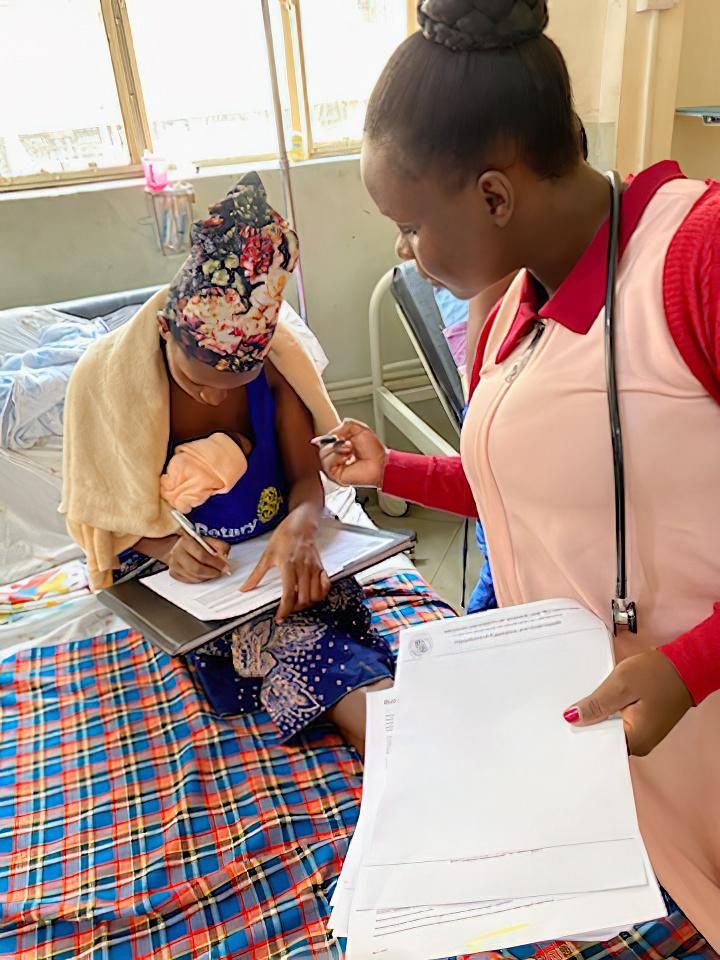
A Rotary Foundation global grant supported a project to upgrade the kangaroo mother care program at a hospital in Uganda.
Courtesy of Doug McMillan.
Since then, multiple studies have shown kangaroo mother care saves newborn lives: It maintains better temperature, improves nutrition and growth, decreases infection, and enhances the bonding between the mother and the baby, explains McMillan, a member of The Rotary Foundation Cadre of Technical Advisers. It has benefits for mothers too, reducing postpartum depression and enhancing their perceived ability to care for their newborns.
Kangaroo Mother Care (KMC),[1] which involves skin-to-skin contact (SSC), is an intervention to care for premature or low birth weight infants (LBW). The technique and intervention is the recommended evidence-based care for low birth weight infants by the World Health Organization(WHO) since 2003.[1][2]
In the 2003 WHO Kangaroo Mother Care practical guide,[1] KMC is defined as a "powerful, easy-to-use method to promote the health and well-being of infants born preterm as well as full-term", with its key components being:
- Early, continuous and prolonged skin-to-skin contact between the mother and the baby;
- Exclusive breastfeeding (ideally);
- Initiated in hospital a hospital setting, and can be continued at home;
- Allows for early discharge of the baby to the family;
- After discharge, Includes close follow-up
The early KMC technique was first presented by Rey and Martinez in 1983,[1] in Bogotá, Colombia, where it was developed as an alternative to inadequate and insufficient incubator care for those preterm newborn infants who had overcome initial problems and required only to feed and grow. Decades of research and development, much from researchers from emerging economies, has improved upon the initial work and has documented that modern evidence-based KMC lowers infant mortality, the risk of hospital-acquired infection, increases weight gain of infants, increasing rates of breastfeeding, protects neuromotor and brain development of infants, improves mother-infants bonding, among others.[3] Today, the WHO recommends "Kangaroo mother care (KMC) for preterm or low-birth-weight infants should be started as soon as possible after birth"[2] based on "high-certainty evidence".